
MES rollout
Seamless data flow and end-to-end connectivity
Febrü Büromöbel GmbH is one of Germany’s leading manufacturers of high-quality furnishing solutions for modern work environments.
Based in Herford, the company has relied on the dmaic MES for several years and has since embedded the solution deeply across all relevant production and logistics areas.
Across 65,000 m², Febrü is a strong example of how an MES can be rolled out seamlessly across every level of the shopfloor without disruption. Full system integration at every workstation creates two key conditions for production management above all: transparency into what is happening across the production environment and the ability to manage operations based on up-to-date information. Over the years, processes have been continuously refined together, digitalized, modules have been expanded step by step and innovations have been implemented. The shopfloor stands out for its complete traceability of every single workpiece from the very moment it enters the production hall.
Transparency and traceability across the shopfloor
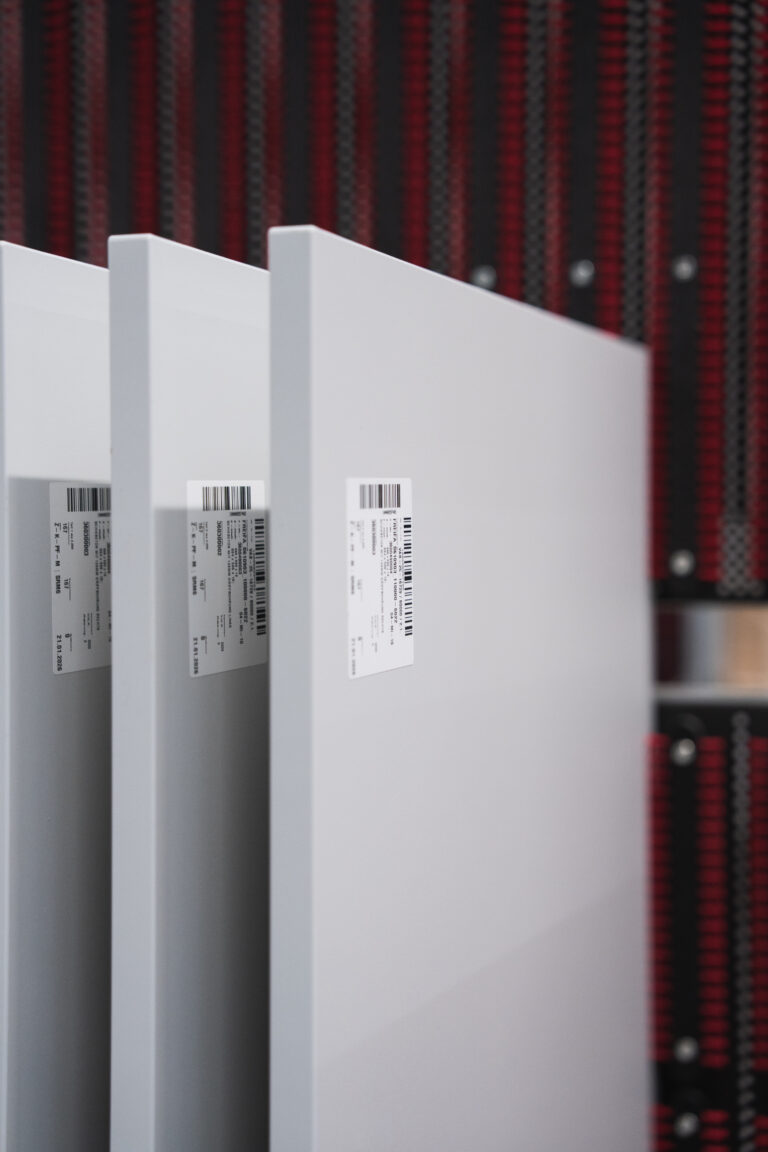
Real-time feedback at the workstation is captured by scanning. The barcode labels required for this are generated and printed by the system directly at the terminal. This also means that every single movement and processing step can be viewed transparently on the shopfloor screens as well as at office workstations. These real-time data provide critical input for all downstream planning and processing activities. These digital feedback processes continue seamlessly in the warehouse.
Digital warehouse processes and efficient material flow
The digital feedback processes continue seamlessly into the warehouse. Employees pick items using Android devices and report stock movements in real time, while on-screen work instructions guide them through each step of the process. In addition, 3D warehouse control and warehouse management support efficient capacity utilization, enable fast inventory checks at storage locations, and ensure a smooth flow of materials.
If disruptions in material flow, high rework rates, or bottlenecks do occur, responsible teams can identify them at a glance directly at the workstation and address the root cause immediately. KPI dashboards also provide meaningful reports that can be exported in seconds, making performance trends easy to compare. The same applies at the operational level, where targets are communicated via web-based dashboards. These show employees directly at their workstation whether the delivery reliability of the next order is being maintained.
Real-time operational control with KPI dashboards
This real-time control is complemented by a planning module that allows manual intervention in the processing sequence of orders. Overall, the close integration of these digital tools creates a production environment in which information is not only available, but actively used to manage and continuously optimize processes. Thanks to the modular system architecture and the well-structured data foundation, new functionalities can be implemented within short timeframes and expanded step by step.
One of the most recent implementations is the web-based maintenance manager, which systematizes preventive maintenance and minimizes machine downtime through forward-looking maintenance planning. The benefits of this MES structure are evident in day-to-day operations on several levels: paper-based processes have been completely eliminated, reducing not only administrative effort but also the risk of errors and lost documents. Search processes, which previously consumed a significant share of working time, have been almost entirely eliminated — every part, every order, and every transport trolley can be located within the system.
End-to-end integration for error-free processes and on-time loading
A clear example of this is the loading zone. Here, not only are the orders assigned to a specific route listed, but their current processing status is also displayed in real time. Employees in the loading area can immediately see which items have already been picked, which are still in production, and how far the loading process has progressed. This transparency enables precise prioritization and prevents delays caused by incomplete shipments.
The technical foundation for this is the system architecture, in which the MES is seamlessly integrated with the ERP system and the CAD solution. This integration enables a fully digital flow of data from order entry and design through to production and delivery, without any manual transfer steps. The resulting reduction in errors has a direct positive impact on customer satisfaction, while costs are also reduced through more efficient use of resources and less rework.