
Digitalization
The digitalization impact of an MES lies primarily in transforming manual, paper-based processes into digital workflows. Information is captured systematically within the system, while activities on the shop floor or in the warehouse are supported by the system and documented in a transparent and traceable manner.
- Early warning system: Bottlenecks can be identified at an early stage.
- Time savings: Manual processes are automated and accelerated.
- Transparent information exchange: Coordination loops are reduced because every employee works with the same data source.
- Quality improvement: Error rates are reduced through digitally guided work instructions.
Goods Receipt
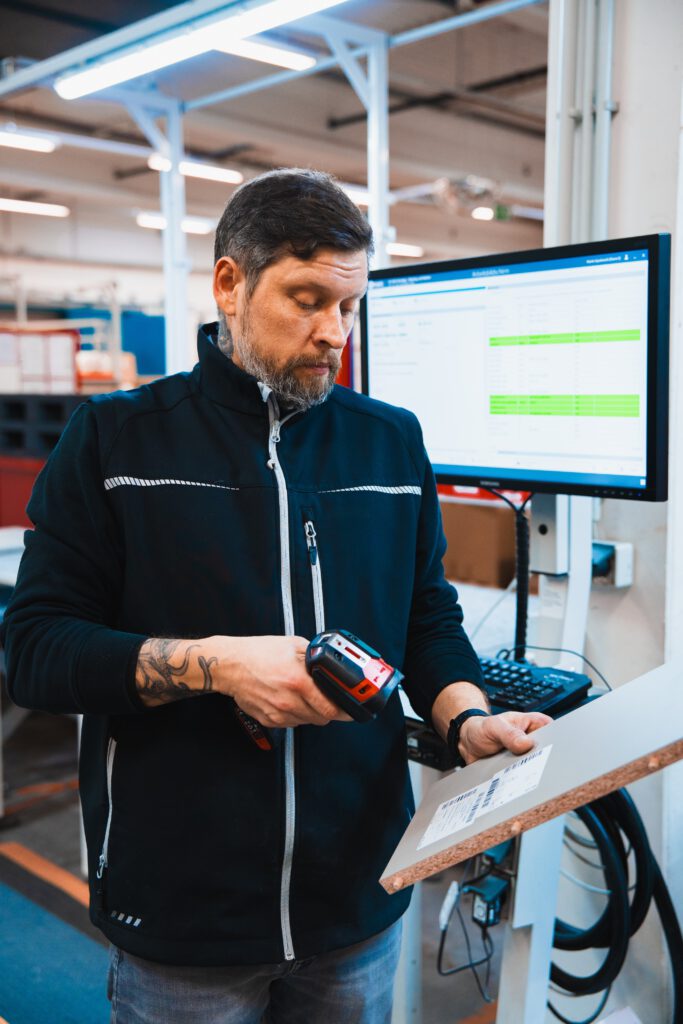
In all downstream process steps, a single scan is sufficient to report back workpieces or processing steps. Manual entries are no longer required but remain possible at any time. This saves time, reduces errors and ensures transparent materials management.
The module can be integrated with existing ERP systems and creates the foundation for stable production processes, optimized inventory management and clear traceability all the way through to shipping.
Mobile Picking
The answer to time-consuming picking processes with long walking distances and paper-based documentation lies in a mobile application. Using the Android app picking is carried out easily via scanning and posted with minimal manual effort.
Mobile picking not only saves time and effort but also ensures high quality standards. Employees receive their orders and bills of materials directly on the mobile device supported by clear and concise work instructions. This guides them through the process efficiently and safely.
No matter where they are on the shop floor material movements can be posted quickly and accurately into the system via scanning.
Material Flow Control
Material flow in production is a decisive factor influencing the efficiency of all operational processes. Well-designed material flow control leads to significant time savings and noticeably improves the use of capacities and resources.
When configured correctly, it ensures that employees can work more productively, materials are available at the right place at the right time and delivery deadlines are reliably met. dmaic works with you to analyze your existing processes and develop a material flow control solution that is precisely aligned with your workflows and systematically improves them.
This starts with the optimal placement of materials in the warehouse and extends to the most efficient solution for all material movements.
A high-performance material flow is further supported by the integrated optimization modules within the planning process. The combination of sequence optimization and automated scheduling defines optimal material routes and prioritizes resource-efficient and effective utilization.
Transport Trolley Management
Efficiency is not created only at the machine. It is just as critical in the supposedly small intermediate steps. The perfect example: the rack trolley. Our MES turns simple rack trolleys into connected assets with a clear structure and full traceability.
Rack trolley control is a central component of material flow control, especially when feeding automated systems. By clearly assigning parts to individual compartments, robots always know exactly from which position the respective component needs to be picked. This transforms the rack trolley from a simple means of transport into an integrated, controllable element within the automated production process.
Warehouse Management
The warehouse management system from dmaic software is the core of digital warehouse logistics. It provides a fully traceable representation of the physical warehouse and forms the central foundation for controlling and documenting all goods movements.
In the dmaic MES, every warehouse and production location can be parameterized individually. Configurable attributes allow warehouse structures to be precisely aligned with operational workflows and logistics requirements. Every physical workpiece receives a digital twin, enabling all movements to be clearly recorded and documented.
Parts are uniquely identified and reliably posted through barcode or QR code scanning. The posting is transmitted to the MES in real time and to the ERP system if required. As a result, all inventory levels are updated immediately. This turns every material movement into automatically registered information.
For retrieval processes, the system supports predefined routing. Material is retrieved in a logically coordinated sequence, reducing travel distances, minimizing search times and enabling more targeted control of picking and staging processes.
Definable inventory thresholds ensure that replenishment requirements are identified at an early stage. As soon as stock falls below a defined minimum level, a replenishment request can be triggered automatically. This supports material availability, process reliability and a continuous supply to production.
The digital mapping of all storage locations and material flows enables complete traceability at any time: At which station is a part currently located? Which processes has it already passed through? When were system postings made? This transparency creates the foundation for quality documentation, production reliability and end-to-end documentation along the entire value chain.
3D Warehouse Control
3D warehouse management opens up new possibilities for the centralized control of high-bay warehouses and floor storage areas. Thanks to flexible camera control, interactive navigation within the digital warehouse twin is possible at any time. Material movements can be executed both fully automatically and manually.
The entire stacking logic can be precisely defined in advance. Movement commands are automatically prioritized based on configurable criteria, enabling intelligent control of storage and retrieval processes. Warehouse areas can be divided into single-type, group-dynamic or random storage zones, providing maximum flexibility and order. Regardless of the warehouse type, whether high-bay or floor storage, panel materials and components are positioned in a way that efficiently prepares subsequent process steps. This results in noticeable time savings across the workflow.
All warehouse movements are fully recorded, including all information on material status, positions and stack structures. An intuitive 3D interface provides all relevant details at a glance. Color markings for occupied locations, disruptions and available spaces create maximum transparency in warehouse control. Existing capacities are utilized efficiently and intelligent pre-picking ensures noticeable time savings throughout the process.
We focus on a modern 3D operating concept that enables intuitive use of all functions. This ensures safe and efficient real-time warehouse control.
Workscreens HMI
The intuitive HMI operator screens of the MES provide all relevant information exactly where it is needed: directly at machines and workstations on the shop floor.
Work instructions, technical drawings, order details, bills of materials and status messages are displayed clearly on a central interface. The information provided is precisely tailored to the respective workstation, process step and user context.
dmaic mes
Digital Transparency
Information becomes more easily accessible in day-to-day operations and overall transparency increases.
System-driven processes
Expert knowledge is embedded directly within the system to eliminate dependencies.
Real-time control
Operations are reported as completed in real time and updated automatically within the system.
Reduced production costs
Cost savings are realized through reduced material consumption, optimized process flows and the elimination of manual workload.
Quality enhancement
Standardized processes and guided workflows elevate quality standards and proactively reduce errors in day-to-day operations.
Efficient resource utilization
Clear transparency and automated controls enable the efficient use of resources and storage capacity.