
Planning
Dmaic provides innovative solutions to manage production planning in lot-size-one manufacturing in a forward-looking, intuitive, and efficient way. Intelligent algorithms translate expert knowledge into automated standards that operate independently.
With our MES, you maintain full visibility over production planning and gain the ability to optimize detailed scheduling according to your specific requirements. Using production simulation, plans can be tested under realistic conditions before execution.
- Reliable and goal-oriented production planning.
- Optimal machine utilization: Transparent capacity overview and balanced utilization of all resources.
- Automated rescheduling replaces manual effort: Algorithm-based planning and reduced manual intervention.
- Cost reduction through material savings, reduced effort, and optimized sequencing in detailed scheduling.
- Production simulations avoid high-risk decisions: Real-time simulation of planning scenarios.
- Planning stability instead of person-dependent decisions: Transfer of expert knowledge into standardized processes.
Backward Scheduling
Scheduling Tool
Well-designed production planning is essential, yet it must remain practical and easy to implement. With the integrated planning tool, scheduling is carried out in a standardized, structured way with minimal effort.
The interface is intuitive: orders can be grouped, sorted, and filtered with ease. A capacity utilization chart provides an immediate overview of how production resources are being used, enabling targeted resource management.
As a result, the planning tool becomes a reliable instrument that noticeably reduces workload and simplifies daily planning processes. In addition, it can be directly connected to further optimization modules, such as material cutting optimization or sequence optimization.
Automatic Scheduling
This reduces planning effort, saves valuable personnel resources, minimizes scheduling errors and ensures stable production processes even under high capacity utilization.
dmaic software combines proprietary planning logic with a Fraunhofer Institute optimization core for cutting optimization. Material usage is calculated and optimized, material waste is reduced and costs are lowered over the long term.The results are available directly in the system and can be transferred into the production process without additional coordination or manual rework.
Cutting Optimization
Dmaic combines its own planning logic with an optimization engine from the Fraunhofer Institute for cutting optimization. Material usage is computationally optimized scrap is reduced and costs are sustainably lowered.
The results are available directly in the system and can be transferred into the production process without additional coordination or manual rework.
Sequence Optimization (dsProSequence)
The software ensures optimized utilization of machines and operating resources, prevents overload situations as well as idle times and significantly reduces setup times. As a result, on-time production and maximum value creation are ensured under real-world production conditions.
Production Simulation
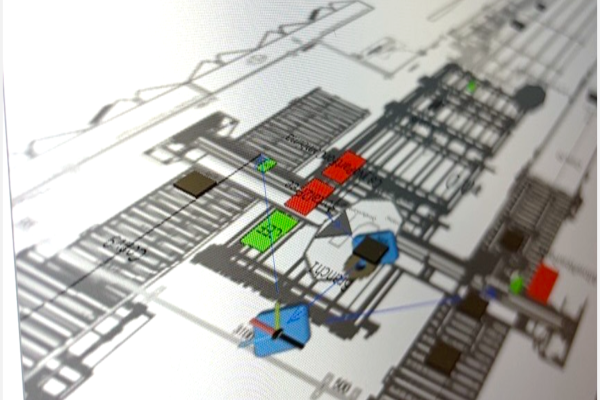
Manufacturing simulation goes far beyond digital copies of individual workpieces: the entire shop floor is represented as a digital twin. Complete production lines, conveyor and transport speeds as well as the processing times of individual workstations are incorporated directly into the simulation. Real production processes are accurately replicated and made available as a reliable basis for production planning. Times and processing steps can be individually adjusted and extended by the user.
In parallel with order optimization, dsProSequence creates a realistic digital simulation of the production environment. Based on the respective cutting plan sequences, different production scenarios are generated automatically and evaluated in terms of their economic efficiency. Planners are provided with a sound decision-making basis and can specifically select the most economically advantageous production order.
Stack Optimization
Manual planning of these processes is time consuming and ties up valuable personnel resources. Automated stacking optimization takes over this task completely and brings structure and efficiency to your processes. The system automatically calculates the optimal arrangement of workpieces on pallets carts or other transport equipment with a focus on stability maximum space utilization and the consideration of downstream process steps.
Storage and transport areas are used optimally relocations are reduced to a minimum and the material flow remains transparent and organized at all times.
The result: less effort shorter distances and consistently reliable processes.
Packaging Optimization
By using rule-based algorithms, the level of automation in the packaging process can be significantly increased. This is especially relevant for batch-size-one production with constantly varying part combinations.
Software-optimized packaging unlocks significant savings potential by eliminating inefficient manual packaging planning.
Fully configurable variables and parameters ensure that dmaic packaging optimization can be used without restriction in existing processes and machine environments. The definition of a rule set in combination with broad compatibility enables both manual and partially automated packaging processes to be mapped.
For a smooth logistics process, it is essential to take into account the packaging-relevant properties of the specific workpieces. For example, the system ensures that furniture components with pre-mounted fittings are arranged in such a way that mechanical stress, friction or scratches between the workpieces are avoided.
This allows existing optimization potential in the packaging process to be fully leveraged while proactively preventing product damage.
The solution automatically assigns the optimal packaging line and provides the operator with specific instructions for the ideal package composition at the scan terminal. Package size and material properties are taken into account, as are process-safe requirements for correct packaging.
dmaic mes
Digital Transparency
Information becomes more easily accessible in day-to-day operations and overall transparency increases.
System-driven processes
Expert knowledge is embedded directly within the system to eliminate dependencies.
Real-time control
Operations are reported as completed in real time and updated automatically within the system.
Reduced production costs
Cost savings are realized through reduced material consumption, optimized process flows and the elimination of manual workload.
Quality enhancement
Standardized processes and guided workflows elevate quality standards and proactively reduce errors in day-to-day operations.
Efficient resource utilization
Clear transparency and automated controls enable the efficient use of resources and storage capacity.