
Monitoring
Reports explain the past. Real time data steer production.
Anyone who sees all relevant information in context at any time identifies bottlenecks early saves analysis time and makes the right decisions faster.
- Live overview of all production KPIs
- Seamless traceability of individual parts and orders
- Early detection of bottlenecks
- Reliable basis for decision making
Track and Trace
Die Track-and-Trace-Funktion des dmaic MES schafft Transparenz über den gesamten Fertigungsprozess bis auf Werkstückebene. Produktionsschritte, Maschinenzustände, Bearbeitungszeiten und relevante Prozessinformationen werden eindeutig dem jeweiligen Auftrag oder Bauteil zugeordnet und zentral verfügbar gemacht. Dadurch lässt sich der aktuelle Status eines Werkstücks ebenso nachvollziehen wie dessen bisheriger Produktionsverlauf. Bei Qualitätsabweichungen, Störungen oder Rückfragen stehen belastbare Informationen schnell zur Verfügung, um Ursachen gezielt einzugrenzen und fundierte Entscheidungen zu treffen. So stärkt Track and Trace die Prozesssicherheit, unterstützt die Qualitätssicherung und bildet eine verlässliche Grundlage für effiziente Steuerung, Analyse und kontinuierliche Optimierung der Fertigung.
MDA/BDA/OEE-Dashboard
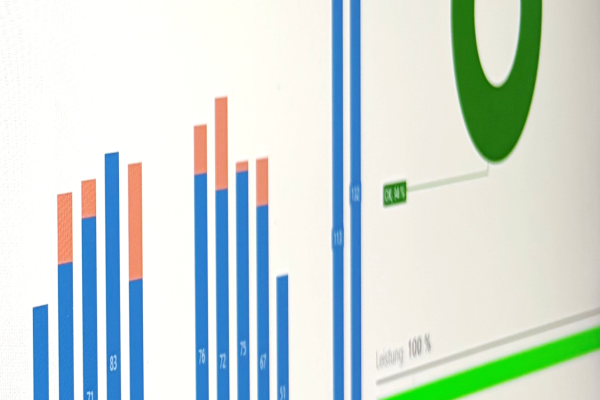
Real-time data only creates value when it can be interpreted immediately. The system automatically prepares key figures and replaces manual reporting with system-supported analyses. Overall Equipment Effectiveness (OEE) is calculated continuously and presented transparently.
You define which key figures are critical for your production. We make them available on central dashboards or directly at the workstations. Working times, availability, throughput times, rework rates, downtime and performance values can be evaluated centrally. Progress, quality and productivity therefore remain measurable at all times.
Plant Visualization
The user-friendly plant visualization makes complex production systems easier to control and provides key information in a clearly structured format. Machine status, order progress and fault messages are visible directly on the interface and can be assessed quickly.
In combination with the MES, a consistent information and control flow is created from planning through to execution. This increases process transparency, supports early fault detection and improves system availability through leaner operating processes.
In addition, dsProductionMetrics brings production targets from the planning level directly to the shop floor. The tool shows whether work progress at a station is running at the planned pace in order to meet the next relevant delivery deadline. To do this, target and actual performance are continuously compared and deviations are highlighted immediately.
Maintenance Manager
The maintenance dashboard makes it easy to plan maintenance tasks and track them reliably. Employees can create new maintenance schedules for upcoming actions with minimal effort, while target values for production-based maintenance can be defined quickly and in a structured way. This keeps all maintenance activities visible at all times, helps prevent missed deadlines, and provides a reliable basis for planning maintenance-related downtime. At the same time, it increases transparency and supports compliance with ISO 9001 requirements.
dmaic mes
Digital Transparency
Information becomes more easily accessible in day-to-day operations and overall transparency increases.
System-driven processes
Expert knowledge is embedded directly within the system to eliminate dependencies.
Real-time control
Operations are reported as completed in real time and updated automatically within the system.
Reduced production costs
Cost savings are realized through reduced material consumption, optimized process flows and the elimination of manual workload.
Quality enhancement
Standardized processes and guided workflows elevate quality standards and proactively reduce errors in day-to-day operations.
Efficient resource utilization
Clear transparency and automated controls enable the efficient use of resources and storage capacity.