
Software-Based Optimization for Batch Size One
Packaging Optimization at Dickmänken GmbH
As a specialist in the online sale of custom-made furniture, Dickmänken GmbH, based in Rheine, Germany, faces the daily challenge of producing individual customer orders efficiently. A wide variety of decors, fittings, product variants and millimeter-precise customizations results in an almost unlimited number of product combinations throughout production and packaging. As part of its digitalization strategy, the company relies on the packaging optimization solution from dmaic software.
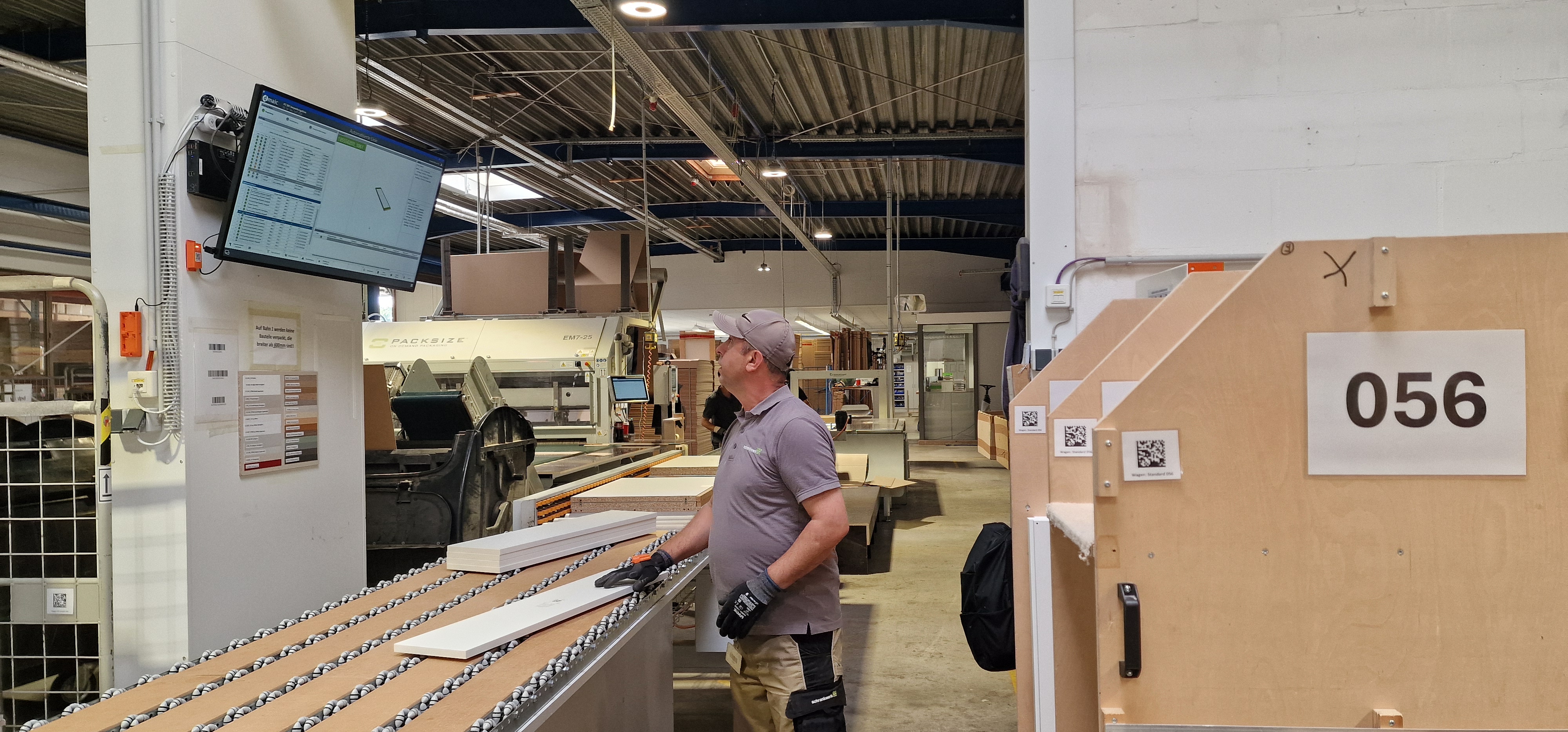
The goal was to standardize packaging processes, reduce material consumption and maintain consistently high packaging quality despite the high level of product variation.
The challenge
Before the introduction of the packaging optimization solution, the packaging of custom-made flat-pack furniture was carried out by employees at two production sites, each operating one manual and one automated packaging line. The composition of each package was largely based on personal experience and established working practices. Despite many employees having years of experience, this resulted in:
• unpredictable packaging material consumption,
• inconsistent packaging quality,
• increased planning effort,
• a higher risk of errors,
• time-consuming packaging processes,
• a dependency on experienced employees being available, and
• an increased risk of transport damage.
The large number of possible part combinations posed a particular challenge, especially in a batch size one production environment.
The solution
With dmaic’s packaging optimization solution, a centralized, rule-based packaging logic was introduced and rolled out across all packaging lines at both production sites. This ensures consistently high packaging quality regardless of individual experience or daily circumstances, even with a high level of product variation. Immediately after the production data is imported, the system automatically calculates the optimal package composition in the background and supports employees with clear work instructions.
At the manual packing stations, employees receive specific instructions on the packing sequence and packaging requirements after scanning a component. At the automated packaging lines, upstream robotic sorting cells and conveyor technology are seamlessly integrated into the process, ensuring that the packing stations are continuously supplied with components in the correct sequence according to the calculated packaging plan. Interfaces to multiple packaging machines have also been implemented, allowing the feeding of a package into a packing station to automatically trigger the cutting of the next shipping carton. Since its dimensions and design have already been determined by the packaging optimization, no manual data transfer is required at any stage. Once the packaging process is completed, shipping labels and shipping information are generated automatically and transferred directly to the downstream logistics processes.
One building block among many: transparency across the entire material flow
By standardizing and digitalizing the packaging process, Dickmänken GmbH achieved several objectives simultaneously:
• higher packaging efficiency regardless of individual experience or daily conditions,
• reduced material consumption,
• faster packaging processes,
• consistently high and reproducible packaging quality,
• prevention of transport damage,
• greater process transparency, and
• reduced workload for employees through clear work instructions.
Today, packaging is fully traceable and no longer depends on individual employee experience. Although transport damage can never be completely eliminated, the system automatically responds to complaints without manual intervention by applying a specially adapted packaging design that provides enhanced protection. This minimizes the risk of the same type of damage occurring again.
When decisions regarding the type and size of packaging no longer have to be made individually for every shipment, the entire packaging process becomes standardized and more efficient. This has a positive impact on both the error rate and employee satisfaction. At the same time, packaging material costs have been reduced while overall process reliability has increased. Packaging is therefore no longer an individual decision but a systematically controlled process.