MES rollout
Steelcase transitions its material flow control to dmaic MES
Steelcase is a global design and thought leader in the world of work. For more than a century, the company has developed and produced workplace furnishings and has collaborated with leading organizations worldwide to create furniture and solutions for the many places where work takes place, including educational institutions, healthcare facilities and the home.
Through extensive research, Steelcase provides insights and design innovations for customers around the world. At the same time, Steelcase is committed to people and the planet and uses its business activities to help the world work better.
At its Rosenheim production site, Steelcase operates a cutting center with connected processing and material flow systems, among other facilities. As part of a retrofit project, modernization measures were implemented there and new system solutions were introduced.
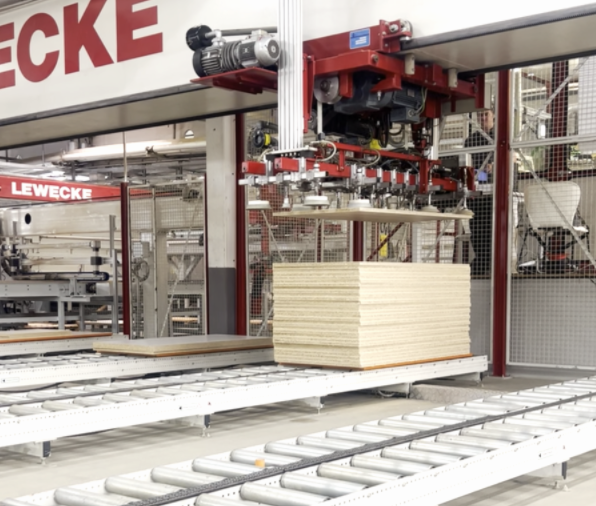
Modernization of control processes within a minimal timeframe
The central control processes in the cutting center were to be modernized and transferred to a higher-level, future-proof system architecture.
The project focused on the following areas:
- floor storage
- cutting/nesting
- picking system
For the final on-site implementation, our team had a tight time frame of 14 days. Any delay would have immediately resulted in unplanned production downtime.
30% increase in material flow control performance
Within the defined project timeframe, the entire control system was successfully migrated to the dmaic MES. The MES now handles the higher-level coordination of all transport orders, including:
- start and destination logic
- coordinates and speed control
- intelligent buffer logic
- stable material flow coordination across all areas
In addition, the new system architecture now enables the parallel and independent operation of two gantries within the transport logic. Transport orders are coordinated without the gantries blocking or slowing each other down.
Another key impact: the scrap rate was significantly reduced. Material-dependent parameterization enables efficient transport and reliably prevents damage to the panels. In addition, additional buffer locations that had previously not been technically integrated can now be used systematically. This increases flexibility in material flow and efficiently absorbs peak loads.
The additional stacks created through the extended use of buffer locations are automatically transferred into the integrated cutting optimization. Separate optimization of these stacks is no longer required. This reduces manual effort and significantly lowers material waste.
Through upstream virtual commissioning, the system was fully tested and validated in advance. Professional project management by Steelcase and the close collaboration with Mechatronik Austria as an experienced PLC partner contributed significantly to the successful implementation.
Cristian BokorSales operations manager, Steelcase AG„The collaboration with dmaic was characterized by great trust and professionalism. From project management to commissioning, dmaic executed the retrofit flawlessly. dmaic’s deep understanding of higher-level plant control proved particularly valuable and contributed significantly to the successful integration. We are very pleased to have accomplished this important step together.“