
How criteria-based sequence optimization measurably reduces lead times
In many manufacturing companies, the primary goal is to shorten lead times, utilize machine capacities optimally and increase overall production performance. Both mass manufacturers and, in particular, batch-size-one operations with highly variant product portfolios and frequent changeovers are confronted with this challenge. There are numerous levers that can influence throughput time, machine utilization or overall output. In production, a wide range of factors affect productivity – from machine occupancy and material availability to set-up times and order prioritization. Managing these interdependencies manually is hardly feasible and often results in time‑consuming coordination efforts and trial‑and‑error planning.
Cost-efficient optimization in detailed planning
For optimal alignment in detailed planning, dsProSequence is available as a solution that has been developed as an integrated component of the MES system. The module automatically determines the most efficient processing sequence for cutting plans, components or finished products and takes all relevant production factors into account, which can be configured individually. Planners can, for example, define whether the system should focus more on short lead times, minimal changeovers or balanced machine utilization. As a result, planning control always remains in the hands of production management, while the tool reliably handles the underlying complexity.
Automated control of key criteria
dsProSequence enables planners to weight lead times, set-up times and machine utilization simultaneously. On this basis, a balanced production sequence is generated that
reduces lead times
improves machine utilization
avoids bottlenecks
increases overall production performance
and minimizes planning effort.
Productivity gains with measurable benefits
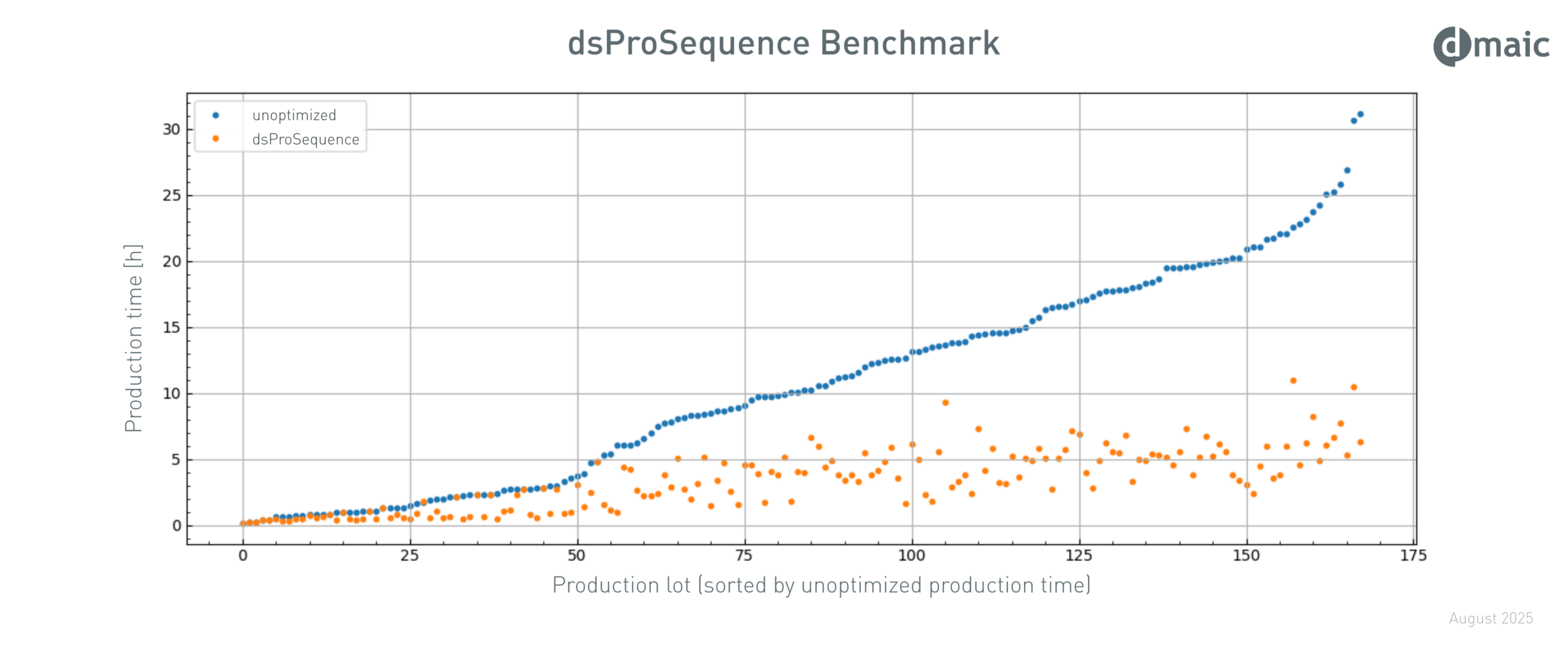
Tests in real production environments show that the use of dsProSequence can significantly reduce total production time. Depending on the production structure and the variety of product variants, lead times can be reduced by measurable percentage values and bottlenecks can be significantly decreased.
The results demonstrate that data-driven sequence optimization not only reduces planning effort, but also clearly improves overall production performance – a key step towards more efficient, stable and future-proof manufacturing.


Leave a Reply